Model for Lung Repair

​Ground-breaking model for lung repair research and trials

Imperial’s Lung Development and Repair Group has devised a highly effective model to track lung repair to support drug development and academic research.

Their AIR Model (Acid Injury Repair) combines the accessibility of ex-vivo study with the accuracy of working with living tissue.

Using this model, the group can deliver:

  • Bespoke studies of small molecules and growth factors to drive repair
  • Drug testing from pre-clinical models to phase II, first-in-man trials
  • Real-time imaging to track cell behaviour in damaged tissue
  • Consultancy and training to establish the model in client labs and facilities

They can support all levels of biotech and pharmaceutical product development, as well as offering unprecedented depth of observation for academic research.


Accuracy of in-vivo research with flexibility of ex-vivo material.

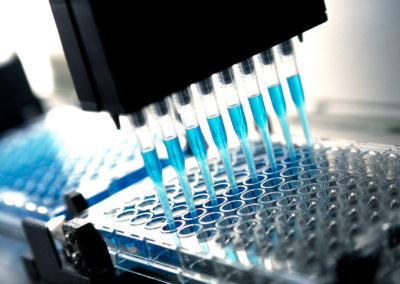
This highly reproducible procedure allows researchers to subject an isolated area of a living lung slice to acid damage, then observe the tissue repair process under a range of conditions.
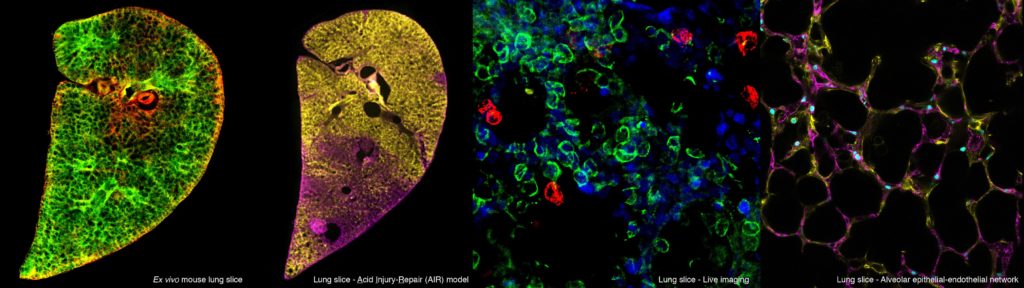
Unlike traditional organoid-based research, the AIR model preserves the full structure of living tissue – and bridges the historic disconnect between lab work and clinical trials.

It can be run on both animal and human samples at a semi-high throughput scale; and includes a real-time imaging solution, deploying fluorescent tags to enable deep observation at a cellular and sub-cellular level – previously impossible with living tissue.

AIR Model samples also preserve tissue-resident macrophages, offering an indication of immune response that is often unavailable in organoids.


Leading Regenerative Medicine Lab

The Lung Development and Repair Group is a multi-disciplinary team of clinicians and researchers with an international reputation, experienced in working with a range of in vivo and ex vivo models across animal and human subjects.

The team can deliver a full development process from pre-clinical models to clinical trials, whilst Dr Sek-Shir Cheong can also consult on its application other settings, including other areas of regenerative medicine.

“The AIR Model has allowed us to work with much greater control at all levels of drug development and research – whether we’re looking to affect signalling pathways, searching for new pro-repair factors or simply following cell behaviour in damaged tissue. We’re excited to apply it in support of clients and partners in industry and wider research fields.” Group Head Dr Charlotte Dean


Click here to read more about the team, the AIR model and their work… 

Including: real-time imaging of lung slices


Current projects:

And Publication: The acid injury and repair (AIR) model: A novel ex-vivo tool to understand lung repair

Our consultants are world-leading experts in their field, committed to on-going research and innovation, and here to help with your challenges. 

Related Insights

Modelling an unprecedented pandemic

Modelling an unprecedented pandemic

During the COVID-19 pandemic, scientists tried to understand the behaviour of the tiny virus particles as well as their effects on very large numbers of human hosts, attempting to bridge these two worlds coherently. But ‘the science’ isn’t a singular entity: it’s highly collaborative, consensus based – and yes, subject to uncertainty. read more

Life after lockdown: COVID-19 response

Life after lockdown: COVID-19 response

Imperial's experts, from a wide range of disciplines, have and continue to keep us informed about COVID-19 and the coronavirus response, save lives through vaccines and testing - and provide solutions to protect the NHS. read more

Carbon capture and storage

Carbon capture and storage

Imperial researchers are working to make CCS more efficient, fine-tune our understanding of risk, and develop economics and policy proposals. read more

Related case studies

Management of pests and vectors of disease

Management of pests and vectors of disease

Helping small-holder farmers with cost-effective techniques to manage pests and vectors of disease, reducing the use of chemical pesticides and promoting the efficiency of natural processes. read more

Cystic Fibrosis clinical advisory board

Cystic Fibrosis clinical advisory board

Our consultants shared their expertise in Cystic Fibrosis (CF), drug development and clinical trials to help Proteostasis Therapeutics assess the combination of compounds aimed at treatments to improve lung function. read more

Neuropathic pain drug development

Neuropathic pain drug development

Our consultants shared their expertise in neuropathic pain area treatments to support Spinifex’s drug discovery and development programs. read more

Latest news

Press Release: Imperial team join IfM Engage consortium to boost UK semiconductor sector

Press Release: Imperial team join IfM Engage consortium to boost UK semiconductor sector

Team from Imperial join IfM Engage consortium, commissioned by the Department for Science, Innovation & Technology (DSIT), for a study into infrastructure to grow the UK semiconductor industry - and a new strategic coordination function for the sector. read more

Prof David Nethercot appointed as assessor to assist Grenfell Tower Inquiry Chairman

Prof David Nethercot appointed as assessor to assist Grenfell Tower Inquiry Chairman

David Nethercot, Emeritus Professor of Civil Engineering, has been appointed by the Chairman of the Grenfell Tower Inquiry to assist him in considering technical issues relating to the design and construction of the building and its refurbishment. read more

Imperial’s new COVID-19 testing lab goes live

Imperial’s new COVID-19 testing lab goes live

Imperial’s contribution to the Testing Alliance launched. Includes the UKAS accredited Molecular Diagnostic Unit (MDU) and existing high-throughput robotic platform for RNA extraction. read more