
News & Events
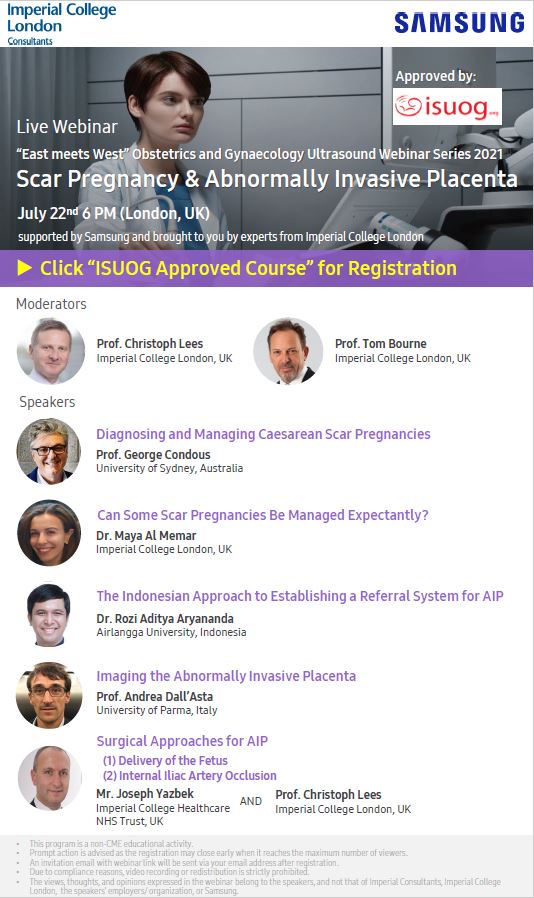
Book your place at the “Scar pregnancy & abnormally invasive placenta.” webinar at 6pm (UK) on the 22nd of July. This is the third in the “East meets West” Obstetrics and Gynaecology Ultrasound Webinar Series 2021 – supported by Samsung and brought to you by experts from Imperial College London, through Imperial Consultants.
The programme:
- Prof George Condous, University of Sydney, (Australia) – Diagnosing and managing caesarean scar pregnancies
- Dr Maya Al Memar, Imperial College London (UK) – Can some scar pregnancies be managed expectantly?
- Dr Rozi Aditya Aryananda, Airlangga University (Indonesia) – The Indonesian approach to establishing a referral system for AIP
- Prof Andrea Dall’Asta, University of Parma (Italy) – Imaging the abnormally invasive placenta
- Mr Joseph Yazbek, Imperial College Healthcare NHS Trust UK and Prof Christoph Lees, Imperial College London (UK) – Surgical approaches for AIP (1) delivery of the fetus (2) internal iliac artery occlusion
Why attend?
Hear about new imaging techniques for abnormally invasive placenta, understand the controversies underlying scar pregnancy, and appreciate the reasons underlying different surgical approaches to delivery and reducing blood loss at Caesarean.
This webinar is for sonologists, sonographers, obstetricians, specialists in fetal medicine, radiologists and midwives.
Places are limited, so register here to secure yours today
Share post:
Latest news, insights and events

Imperial Consultants contribute to novel pain drug success
Australian pharmaceutical company, Spinifex Pharmaceuticals (“Spinifex”) has recently presented the clinical development of their lead product at the 14th World Congress of Pain®, highlighting the success of consultancy through Imperial Consultants. read more
FREE Fetal Heart webinar – ON DEMAND
Catch up on the third in our series of four, educational webinars exploring Fetal Medicine. In this event we will explore cases where fetal cardiology, fetal medicine, clinical genetics and obstetric management are integrated in one patient pathway. Delivered by Imperial’s Professor Christoph Lees, and supported by GE HealthCare. read more

Cricketer set a £1million batting challenge
A leading cricketer has been offered £1million to strike a ball clear of the Lord’s Pavilion, using a new Mongoose bat tested by Imperial Consultants. read more